BitPay vs. Manatee API: Processor or Direct-to-Wallet Payments?
BitPay and Manatee can both put a cryptocurrency option in an online checkout, but they sit in different places in the payment chain.
BitPay is a full payment processor. It creates the customer invoice, supports many wallets and currencies, handles payment exceptions, maintains the merchant ledger, and can settle in fiat or cryptocurrency. Manatee is monitoring infrastructure: it creates a BTC or BCH payment instruction for an address controlled by the merchant and reports what happens on-chain.
That makes this less a feature contest than a responsibility decision. BitPay is stronger when a business wants settlement, conversion, compliance operations, and broad coin coverage delegated. Manatee is relevant when the merchant specifically wants direct BTC/BCH receipt and will retain wallet, refund, and accounting responsibility.
This article uses BitPay's public business, pricing, support, and developer documentation as available on September 2, 2026. Fees and supported assets can change, so verify them during onboarding.
What happens after the customer clicks pay?
BitPay's documented checkout redirects the customer to a BitPay invoice. The customer selects a wallet and payment currency, BitPay reports invoice status through Instant Payment Notifications (IPNs), and a completed invoice is credited to the merchant's BitPay account for settlement. The merchant can choose fiat, cryptocurrency, or mixed settlement.
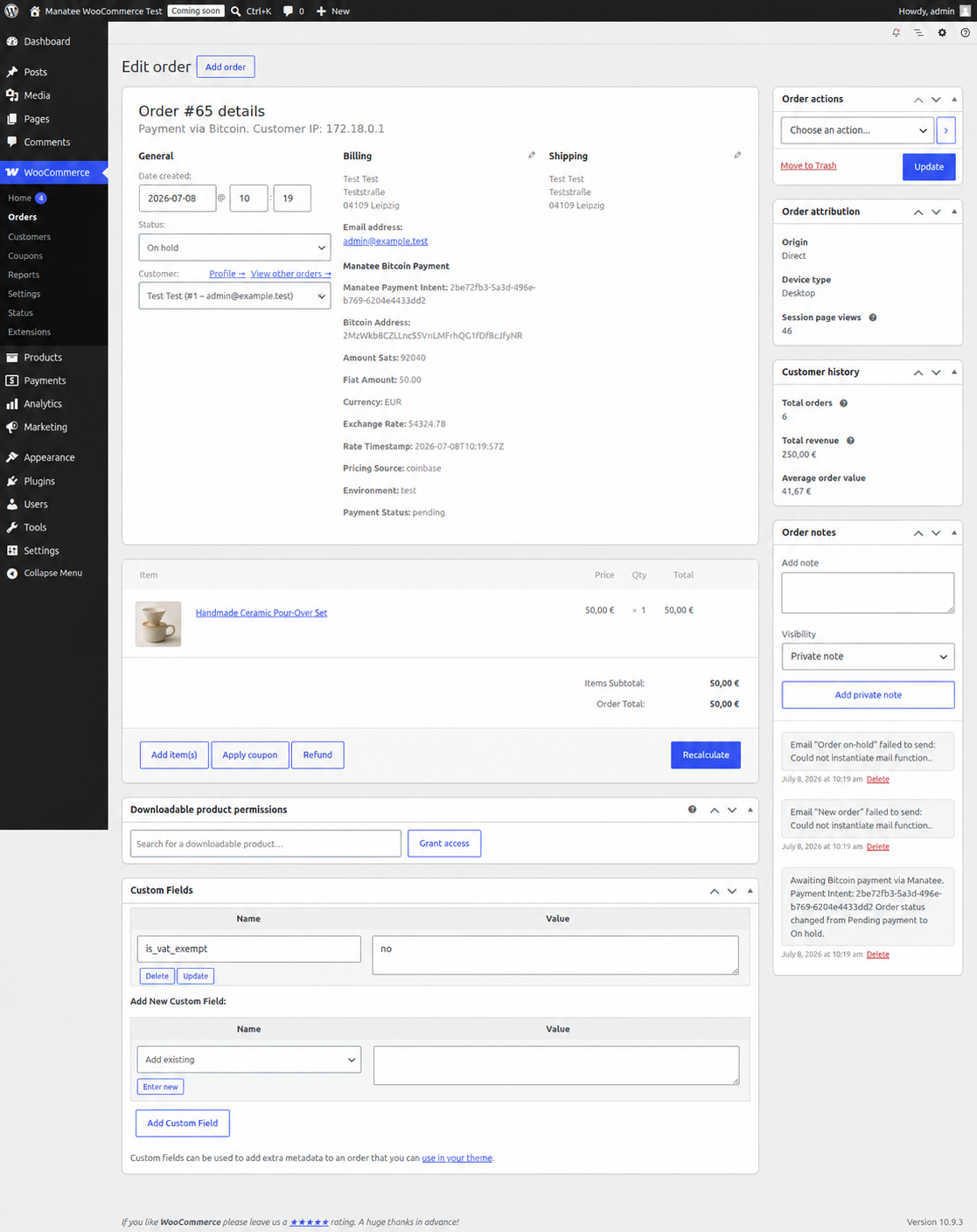
Manatee returns a payment address and amount to the merchant's backend or ecommerce plugin. The checkout is rendered by the merchant integration. Funds travel to that merchant-controlled address, while Manatee records pending, detected, and confirmed states and delivers webhooks. No merchant ledger balance exists at Manatee.
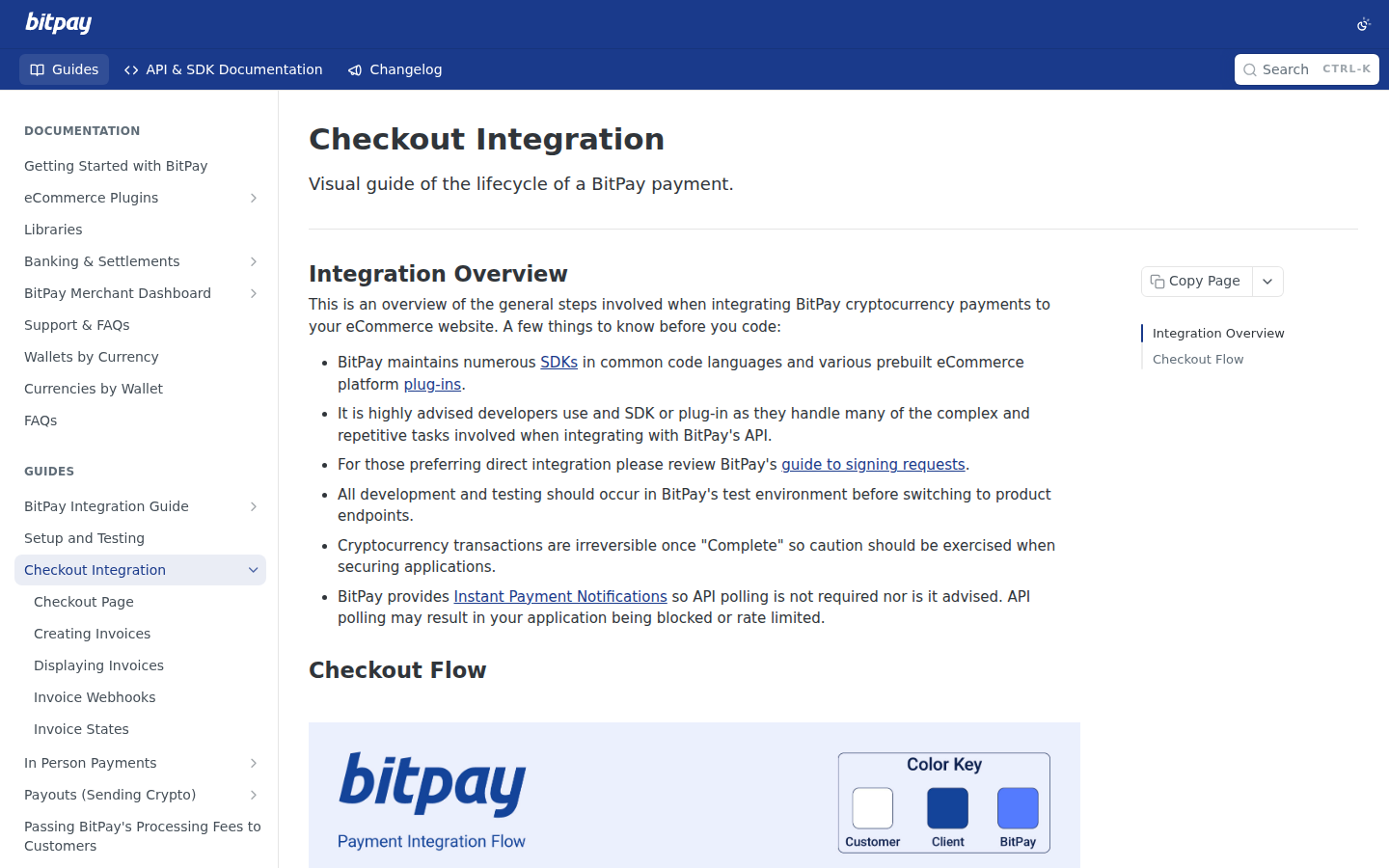
The processor model can remove substantial work. It also means the merchant's payment operation depends on BitPay's invoice, ledger, account status, settlement schedule, supported jurisdiction, and compliance process. Manatee has a smaller dependency surface for funds, but a larger merchant responsibility surface.
A practical side-by-side
| Area | BitPay | Manatee API |
|---|---|---|
| Product category | Cryptocurrency payment processor and payout platform | Hosted on-chain payment monitoring API |
| Customer assets | Advertises 100+ coins across six networks | BTC and BCH |
| Settlement | Fiat, cryptocurrency, or a mixture through BitPay settlement | Directly to merchant-controlled BTC/BCH addresses |
| Conversion | Built into the processing and settlement offer | Quote calculation only; no exchange or conversion |
| Checkout | BitPay-hosted invoice/payment flow plus plugins | Merchant-rendered checkout or Manatee ecommerce plugin |
| Webhooks | IPNs; BitPay recommends status verification and documents optional HMAC handling | HMAC-SHA256 signed events with timestamp and event ID |
| Refunds and exceptions | Processor tooling for refunds and payment exceptions | Merchant handles refunds and reconciliation from its own wallet |
| Merchant onboarding | Business onboarding, KYC/compliance, and supported-jurisdiction rules | Beta account plus wallet/API configuration; Manatee does not provide fiat settlement |
| Pricing | Volume-tiered percentage plus fixed per-transaction amount | €0 beta with technical limits; final production pricing pending |
BitPay's advantage is breadth
BitPay advertises ecommerce, email billing, in-store payments, invoicing, payouts, payroll, affiliate settlement, and B2B payments. It supports fiat bank settlement and a much broader range of cryptocurrencies and stablecoins than Manatee. Its integrations include common platforms such as Shopify, WooCommerce, and Magento.
For a finance team that does not want to manage crypto balances or price exposure, those capabilities are central rather than incidental. BitPay also operates compliance processes that a processor handling settlement is expected to maintain. Manatee cannot substitute for those services: it does not exchange cryptocurrency, open a bank settlement account, screen customers on a merchant's behalf, or produce payouts.
The trade-off is a more mediated payment flow. The merchant receives a processor settlement rather than having every customer payment addressed directly to its own wallet account.
Manatee's advantage is a narrow custody boundary
Manatee supports only on-chain BTC and BCH. A merchant can provide a destination per payment or configure read-only receive data so that a fresh address is derived without sharing a private key. The resulting funds are spendable only by the merchant's wallet.
This model avoids a withdrawal step and keeps the payment asset on its original network. It also exposes the limitations honestly:
- There is no automatic fiat settlement.
- There is no stablecoin or broad multi-chain catalogue.
- There is no Manatee-hosted wallet or recoverable account balance.
- There is no processor-managed refund or payout.
- The merchant decides when to fulfil and handles accounting consequences.
A team choosing Manatee should already have a secure wallet process and a reason to prefer direct asset receipt over processor settlement.
Webhook semantics deserve a real comparison
Both products warn merchants not to treat the first observed payment state as final.
BitPay distinguishes statuses such as paid, confirmed, and complete. Its current integration guidance says a paid invoice is not a payment guarantee and recommends fulfilling after the appropriate confirmed/complete state. The documentation also says IPNs are not signed by default and should trigger a GET request to verify invoice status; an HMAC verification path is documented for integrations that enable it.
Manatee uses detected when a matching transaction has been observed and confirmed only when the configured confirmation threshold is reached. Webhook requests are signed by default over the raw body and timestamp. Consumers must still process them idempotently and may retrieve the payment for reconciliation.
This is not an argument that one status vocabulary is universally better. It means a migration cannot map paid to confirmed by name alone. Your order state machine must reflect the provider's actual guarantee and settlement model.
Pricing: compare what is included
BitPay's public pricing page currently lists the following acceptance fees:
- Below $500,000 monthly volume: 2% + $0.25 per paid invoice
- $500,000–$999,999: 1.5% + $0.25
- $1,000,000 or more: 1% + $0.25
The page notes higher fees for high-risk industries. Network costs, refund-related miner fees, settlement details, and account-specific terms can also matter. These figures should be checked directly before making a budget decision.
Manatee is free during beta, with limits visible in the dashboard. Its planned production model is a monthly flat rate rather than a percentage of payment volume, but neither final prices nor production allowances have been published. It would be misleading to calculate a long-term saving from the beta price.
BitPay's fee includes a substantially broader processor role. Manatee's eventual fee will cover API, node monitoring, confirmation tracking, and webhook delivery while the merchant retains the operational work outside that boundary.
Use these deciding questions
Choose BitPay if several of these are true:
- Customers need a broad choice of cryptocurrencies, stablecoins, and wallets.
- Your finance team wants fiat bank settlement or managed conversion.
- You need processor tooling for invoicing, exceptions, refunds, or payouts.
- Formal merchant onboarding and processor-operated compliance fit your organisation.
- A hosted BitPay checkout is acceptable or desirable.
Consider Manatee if these describe the requirement more accurately:
- Only BTC and BCH on-chain acceptance is needed.
- Each payment should arrive at an address controlled by your wallet.
- You want a server-side API rather than a complete payment-account platform.
- Your team will own refund, wallet, tax, fulfilment, and reconciliation decisions.
- You prefer predictable infrastructure pricing in principle, while accepting that final Manatee pricing is not yet available.
If you need BitPay's settlement capabilities and Manatee's direct-to-wallet property at the same time, neither product exactly matches that requirement. Decide which boundary is non-negotiable rather than assuming an integration setting can provide both.
Primary sources
- BitPay business product overview
- BitPay pricing
- BitPay checkout integration
- BitPay invoice webhooks
- BitPay merchant fee explanation
- Manatee payment lifecycle
- Manatee webhook contract
- Manatee custody model
BitPay and its marks belong to BitPay. This comparison is independent and is not an endorsement by either company.