OpenNode vs. Manatee API: Which Bitcoin Payment Model Fits?
OpenNode and Manatee both let a backend create a Bitcoin payment and react to status changes. Beyond that entry point, they solve different operational problems.
OpenNode combines on-chain and Lightning acceptance with hosted checkout, account balances, conversion, transfers, payouts, and bank settlement. Manatee monitors on-chain BTC and BCH payments sent directly to merchant-controlled addresses. It has no balance to withdraw and no conversion or payout service.
The shortest useful answer is: OpenNode is a better fit when settlement and Lightning are part of the product you want to buy. Manatee is a better fit when direct wallet receipt is the boundary you want to preserve.
Information and pricing below were checked against OpenNode's official site, help centre, and developer portal on September 2, 2026.
Follow the money first
Feature tables often hide the most important difference, so start with the path of a successful payment.
OpenNode flow
- Your application creates an OpenNode charge.
- The customer pays on-chain or through Lightning.
- OpenNode accounts for the payment on its platform.
- Depending on your configuration, value can remain as Bitcoin, be converted to local currency, or be transferred to an external Bitcoin wallet or bank account.
OpenNode documents scheduled and on-demand transfers, a platform Bitcoin wallet, automatic conversion, and local-currency settlement. Those capabilities remove work from the merchant, but they necessarily put OpenNode in the settlement path.
Manatee flow
- Your backend creates a BTC or BCH payment record.
- Manatee returns an address belonging to the merchant's receive configuration, or validates an address supplied by the merchant.
- The customer sends directly to that address.
- Manatee observes detection and confirmations, then sends signed webhook events.
There is no subsequent Manatee withdrawal. Conversion, treasury handling, and refunds happen in systems controlled by the merchant.
The API reveals the product boundary
OpenNode's POST /v1/charges accepts a satoshi or fiat-denominated amount and can return a hosted payment flow. Its documented fields include payer details, callback_url, success_url, time-to-live, notification preferences, and auto_settle for fiat conversion when a bank wallet is configured.
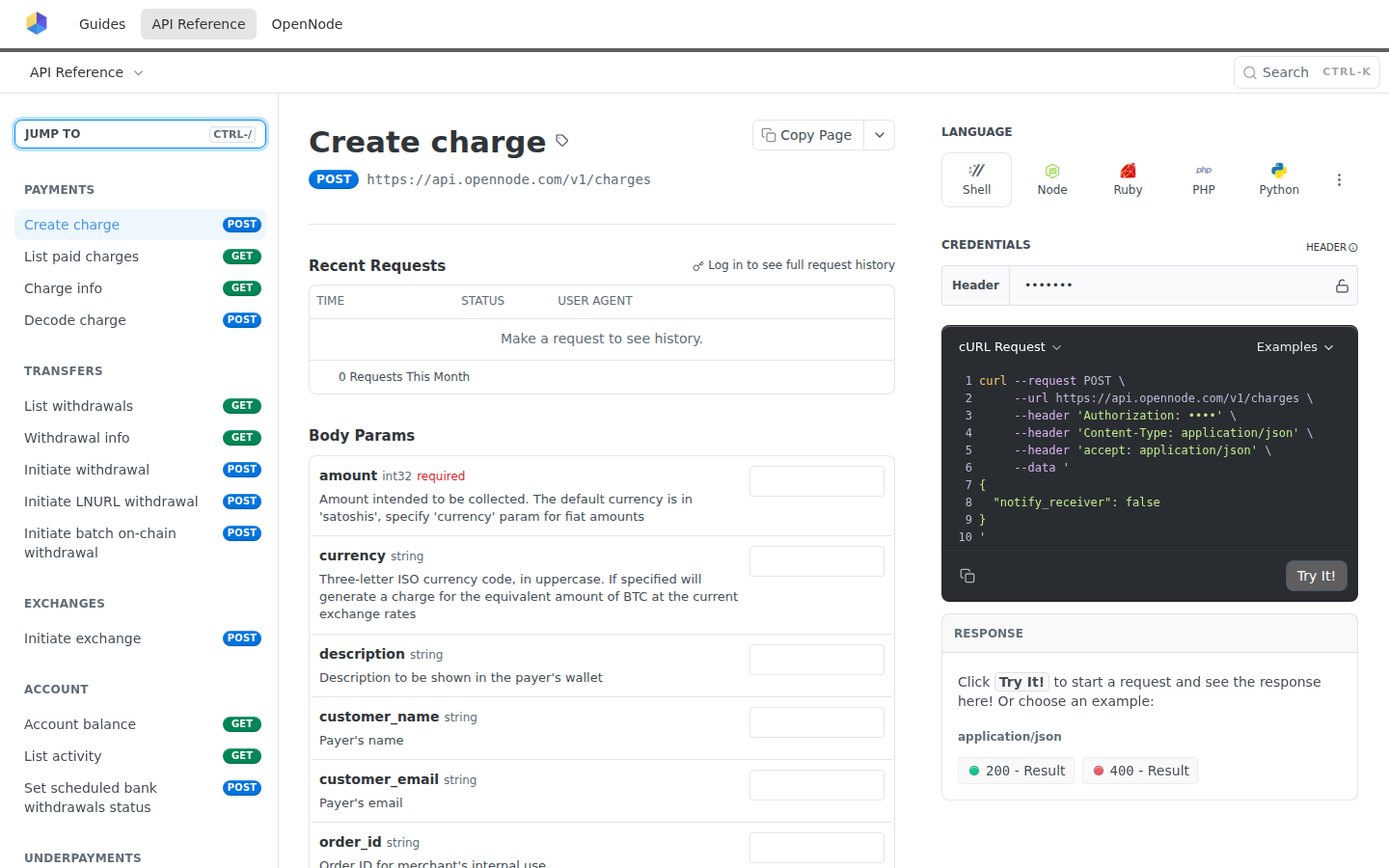
Manatee's create-payment request is intentionally smaller. It accepts satoshis or a fiat amount for quote calculation, a merchant webhook URL, expiry, confirmation policy, tolerance, and an order reference. The fiat fields determine how much BTC or BCH the customer should send; Manatee does not exchange the received asset or settle fiat.
This is not simply a difference in naming. OpenNode's “charge” belongs to a payment-processing account with settlement tools. A Manatee “payment” belongs to an asset/network scope and points at the merchant's wallet.
Capability check
| Requirement | Better fit | Why |
|---|---|---|
| Accept Bitcoin over Lightning | OpenNode | OpenNode provides managed Lightning payments; Manatee's public API is on-chain only |
| Receive local currency in a bank account | OpenNode | Automatic conversion and bank settlement are part of OpenNode's offering |
| Keep part in BTC and settle part as fiat | OpenNode | Split settlement is an advertised capability |
| Accept Bitcoin Cash | Manatee | Manatee supports BCH on-chain; OpenNode positions its service around Bitcoin |
| Avoid a provider balance or later withdrawal | Manatee | Customer funds are addressed directly to the merchant's wallet |
| Use an xpub/descriptor without uploading private keys | Manatee | Address derivation uses read-only receive data |
| Use hosted billing, payouts, or in-person tools | OpenNode | These are part of OpenNode's broader processing platform |
| Control the complete checkout presentation | Depends | Both have APIs; OpenNode also offers hosted pages, while Manatee expects the merchant or plugin to render checkout |
What the WooCommerce experience looks like
Both services can be connected to WooCommerce. OpenNode's official setup uses an ecommerce API key and supports Bitcoin/Lightning through its plugin. Manatee's WordPress.org plugin renders the payment instruction inside the shop and keeps polling as a fallback to webhook-driven order updates.
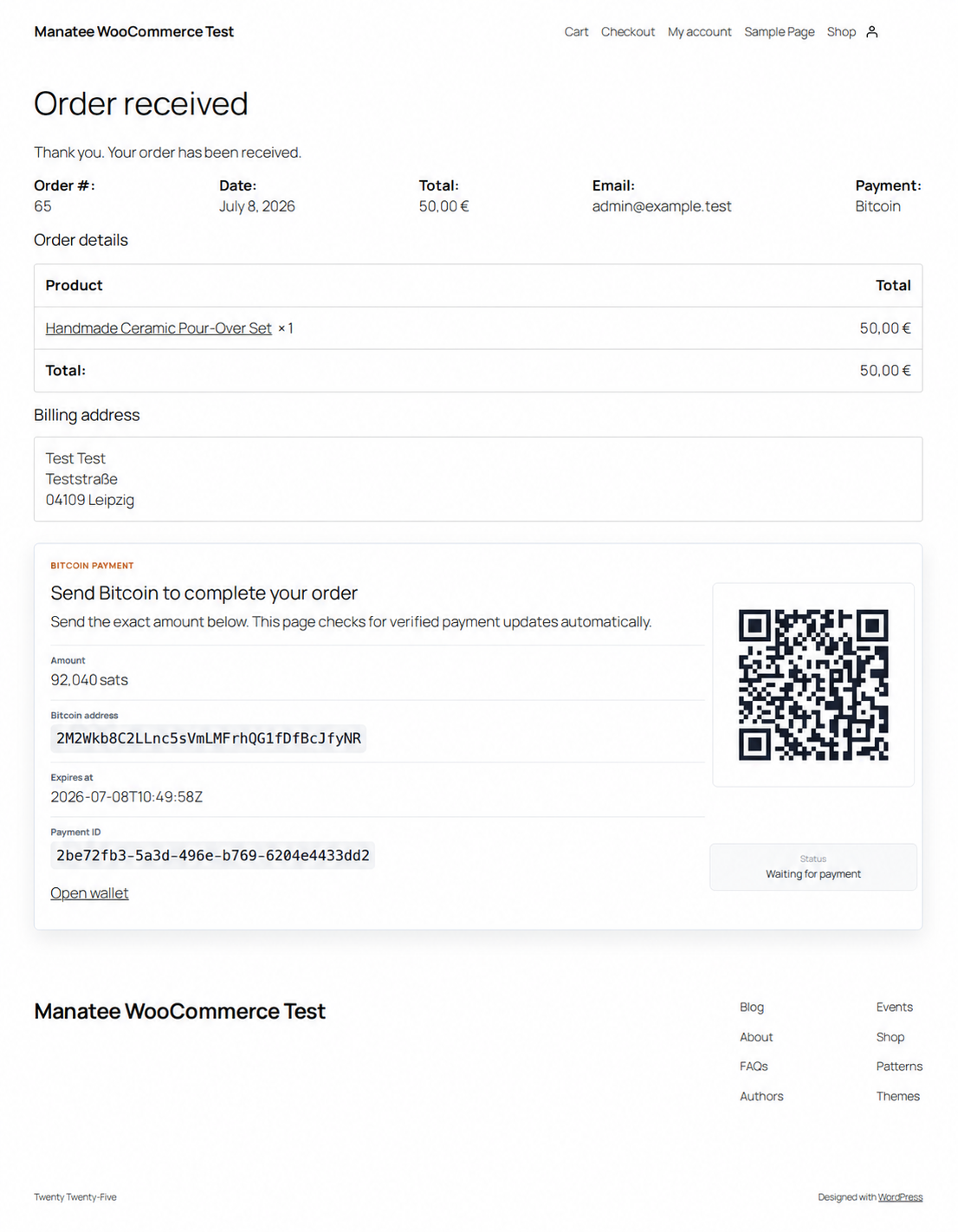
If a hosted redirect, Lightning option, or automatic conversion is essential, the OpenNode plugin aligns better with that workflow. If the checkout should remain inside WooCommerce and settlement must go to the configured merchant wallet without a processing balance, Manatee's narrower model is relevant.
Cost and onboarding are part of the architecture
OpenNode's current help article lists no setup, minimum, monthly, or annual fee and says typical payment and payout processing fees are 1%. It also documents free scheduled weekly Bitcoin transfers, free on-demand Lightning transfers, and a 1% fee for on-demand on-chain transfers. Bank-transfer fees and minimums vary. Businesses complete KYC/KYB as part of onboarding.
Manatee is free during beta and has technical usage limits. It currently offers no paid upgrade, currency conversion, bank transfer, or payout product. A future flat-rate model is planned, but final production prices and allowances are not yet published.
OpenNode's fee buys settlement operations and a broader platform. Manatee's future subscription will buy monitoring infrastructure while leaving settlement operations with the merchant. Comparing only the API call price ignores that difference.
Where each product is plainly stronger
OpenNode has the stronger current offer for merchants who want Bitcoin acceptance to behave like a managed payment processor: Lightning, hosted checkout, conversion, bank settlement, billing, payouts, more ecommerce integrations, and an established operational platform.
Manatee is stronger only for a narrower requirement: BTC or BCH on-chain monitoring with a clear direct-to-wallet boundary, explicit confirmation thresholds, and signed webhook delivery, without operating nodes yourself. That boundary also means Manatee cannot rescue a wallet, convert proceeds, initiate a payout, or issue a refund.
Before deciding, write down the desired end state of a €50 order. If the answer is “€50 in our bank account,” OpenNode's conversion and settlement matter. If it is “the exact BTC or BCH amount in an address derived from our business wallet,” Manatee's direct receipt matters. If it is “settled instantly over Lightning,” Manatee is not currently the right product.
Primary sources
- OpenNode product overview
- OpenNode pricing and fees
- OpenNode developer overview
- OpenNode create-charge reference
- OpenNode integrations
- Manatee pricing and beta limits
- Manatee supported assets
- Manatee receive configuration
OpenNode and its marks belong to OpenNode. This is an independent comparison; neither company has reviewed or endorsed it.