BTCPay Server vs. Manatee API: Self-Hosting or Managed Infrastructure?
BTCPay Server and Manatee can both keep a payment provider away from the merchant's private keys. That similarity is important, but it is not the decision. The practical question is who should operate the nodes, payment database, checkout services, updates, backups, and monitoring.
Choose BTCPay Server when owning and operating the complete payment stack is a feature. Choose Manatee when you want direct-to-wallet settlement but do not want another public server to maintain.
This comparison was checked against the products' public documentation on September 2, 2026. BTCPay Server is an open-source project rather than a conventional hosted payment company; third-party BTCPay hosts introduce a separate set of terms and trust assumptions.
The decision at a glance
| Question | BTCPay Server | Manatee API |
|---|---|---|
| Operating model | Software you self-host, or use through an independent third-party host | Hosted API and monitoring infrastructure operated by Manatee |
| Fund control | Non-custodial; payments go to the configured merchant wallet | Non-custodial; payments go to merchant-controlled addresses |
| Merchant infrastructure | BTCPay application, node connectivity, storage, upgrades, backups, and availability | Store or application integration plus your own wallet and webhook endpoint |
| Payment scope | Bitcoin on-chain and Lightning, plus optional integrations and built-in apps | BTC and BCH on-chain payments on testnet and mainnet |
| API shape | Broad Greenfield API covering stores, invoices, wallets, webhooks, payouts, and more | Narrow payment API covering creation, lookup, cancellation, status, usage, and webhook delivery |
| Refund tooling | Pull Payments-based refund workflow; signing remains part of your wallet process | No refund workflow; the merchant sends refunds from its own wallet |
| Software price | No BTCPay processing or software fee; hosting and operations still have a cost | Free during beta with technical limits; production pricing is not final |
BTCPay Server gives you the whole system
BTCPay describes itself as free, open-source, self-hosted, and non-custodial. A normal deployment includes significantly more than an invoice endpoint: store management, a web checkout, a wallet view, Lightning support, Point of Sale, payment requests, crowdfunding, reporting, and an extensive API.
That breadth is useful when you want one system to be the Bitcoin payment back office. It also means the merchant owns an operational service. The official deployment guidance recommends Docker for production and documents storage, domain, TLS, node, update, and backup decisions. A third-party host can remove some installation work, but then availability, metadata visibility, enabled features, and commercial terms depend on that host.
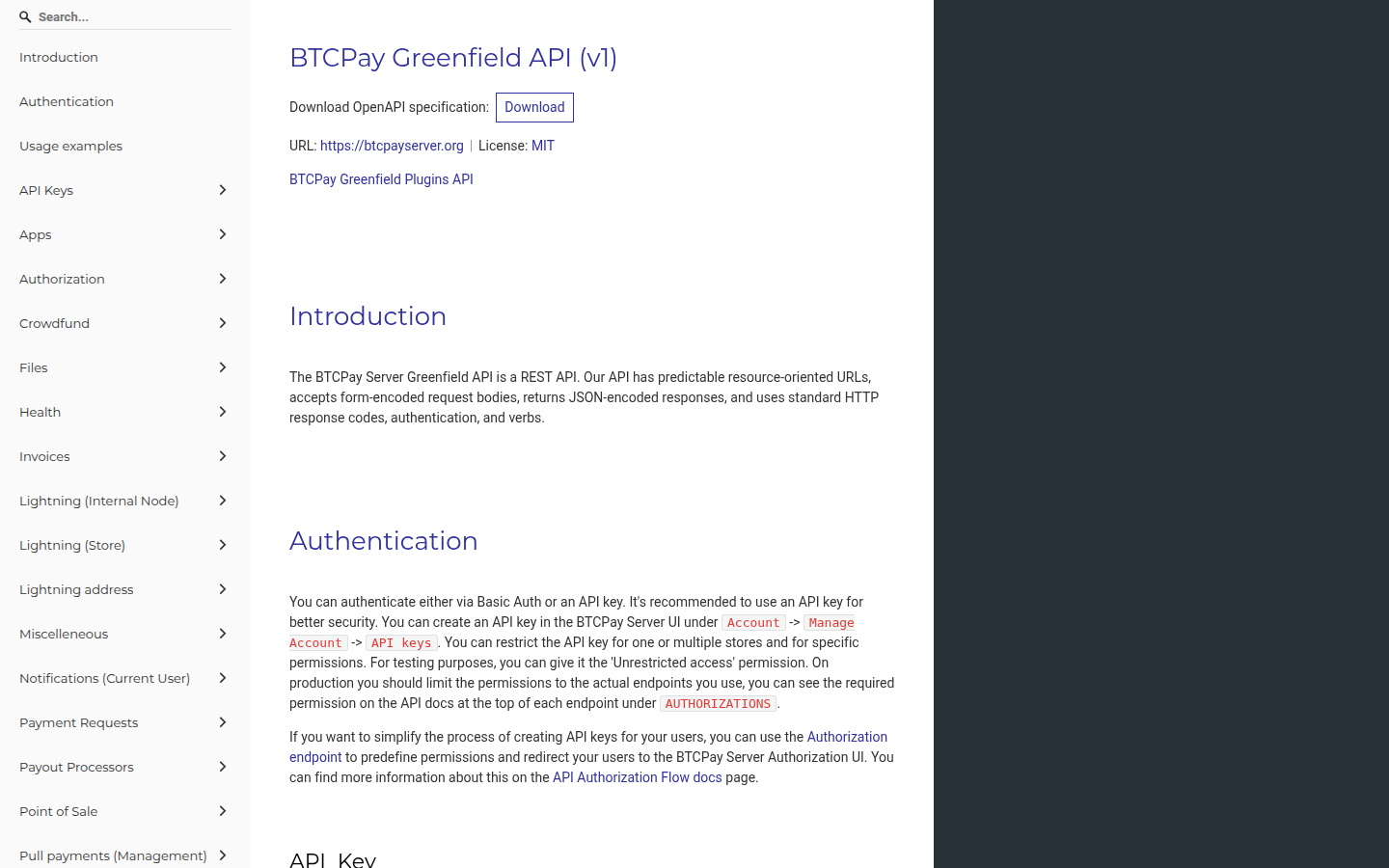
The Greenfield API supports permission-scoped API keys. That is valuable for complex integrations, especially if an application needs to create stores, inspect wallets, manage webhooks, or interact with Lightning. It is more surface area than a team needs when its only requirement is “create an on-chain payment and tell us when it confirms.”
Manatee deliberately exposes less
Manatee is not a hosted BTCPay instance. It does not provide a merchant wallet, Lightning node, Point of Sale application, crowdfunding tools, payouts, or a server administration layer. Its API creates and monitors BTC or BCH payment records, tracks a configurable confirmation threshold, and delivers signed status events.
The merchant supplies a destination address or read-only receive configuration. The private keys remain outside Manatee, and the customer payment does not enter a Manatee balance before reaching the merchant.
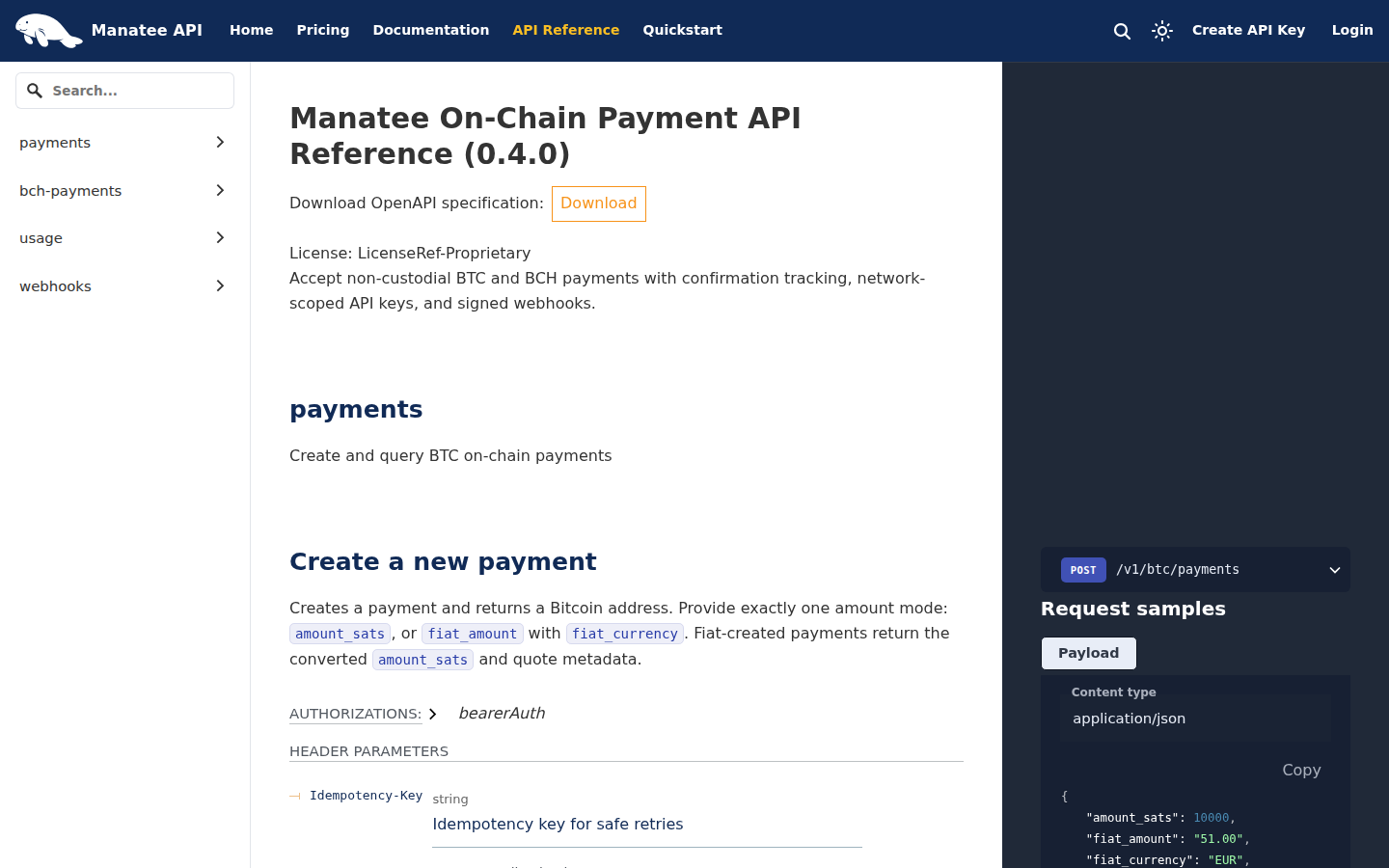
That narrower boundary reduces infrastructure work and integration choices. It also removes capabilities. If your checkout needs Lightning today, an embedded wallet, automated payout construction, or a configurable hosted invoice UI, BTCPay Server is the stronger fit.
“No processing fee” is not the same as “no cost”
BTCPay does not charge a processing, subscription, transfer, or software fee. A self-hosted merchant still pays for a VPS or hardware, storage, backups, monitoring, incident response, and staff time. For a team already operating Bitcoin infrastructure, those costs may be incremental and entirely reasonable. For a small shop, they can be the largest part of the decision.
Manatee currently charges €0 during beta, subject to account limits shown on the pricing page. It is still a hosted dependency and an early-stage product. You are relying on Manatee for timely detection and webhook delivery even though Manatee cannot move your funds. Final production plans and service terms have not yet been published.
Do not compare “0%” with “€0 beta” as if they were permanent, equivalent prices. Compare the expected production subscription with your actual cost of operating BTCPay well.
Two non-custodial systems, two trust boundaries
With your own BTCPay instance, you can validate transactions using infrastructure you control. You also control the application database and decide when to update. A failure in your deployment is yours to diagnose.
With Manatee, the merchant controls spending keys while Manatee controls the availability of the monitoring API. If Manatee is unavailable, funds can still arrive at the merchant address, but order status and webhooks may be delayed. This is less operational responsibility, not trustlessness.
The distinction becomes less clear when using a third-party BTCPay host. BTCPay remains non-custodial by default, but the host operates the node and server, can observe service metadata, and determines available server features. Evaluate that host separately rather than treating every hosted BTCPay account as equivalent to self-hosting.
Choose based on the work you want to own
BTCPay Server is usually the better choice if:
- You want Lightning or BTCPay's Point of Sale, payment-request, crowdfunding, and wallet features.
- You already operate production services and a Bitcoin node, or explicitly want to learn how.
- You need the broad Greenfield API and detailed store-level administration.
- Infrastructure sovereignty and source-level auditability outweigh maintenance time.
- You want software without a provider subscription and understand the total operating cost.
Manatee is usually the better choice if:
- You need a small server-side primitive for on-chain BTC or BCH payments.
- Payments must settle directly to addresses controlled by your business.
- You do not want to expose, patch, monitor, and back up a payment server.
- Signed webhooks and a compact payment lifecycle fit your existing order system.
- You accept that wallet operations, accounting decisions, and refunds stay outside the service.
If neither list is comfortable, do a short testnet exercise with both. Deploy BTCPay, create an invoice, restore it from backup, and simulate a failed webhook. Then run the Manatee Quickstart, verify the signature, and consider what happens if the hosted API is temporarily unavailable. The recovery work usually makes the trade-off clearer than a feature checklist.
Sources and scope
- BTCPay Server overview and features
- BTCPay deployment options
- BTCPay third-party hosting considerations
- BTCPay Greenfield API
- BTCPay refund workflow
- Manatee API and authentication
- Manatee custody boundary
Product names and trademarks belong to their respective owners. Manatee is not affiliated with or endorsed by BTCPay Server.